

The Importance of Anti-Lessons: Why Learning What Not to Do is Sometimes More Powerful Than Learning What to Do
The entrepreneurial journey is one of trial-and-error. If you’re like me and you studied business at a university, it takes about one day on-the-job in the “real world” before you realize that a lot of what you learned doesn't apply to the day-to-day life of most self-made business owners.
Rather than conducting in-depth research and analysis and synthesizing it into beautiful plans, most of us business owners are running a series of experiments. When an experiment works, we double down. When it doesn’t, we shut it down. To a large extent, we are just groping around in the dark.
Along the way, we forge our own unique set of business rules of thumb based on the patterns we’ve experienced over our careers.
I don’t want to take away from my undergraduate business education. I certainly learned a lot of the technical building blocks, accounting, financing, marketing, calculus, etc. But I really think it was in the workplace where I learned many of the most important lessons for business, and I think most business owners probably feel the same.
In this post, I want to talk about a certain kind of lesson that a lot of us find most impactful: the anti-lesson.
For some reason, it’s the anti-lessons, what I define as “what NOT to do,” that tend to stick in my mind. These lessons seem so simple, but the experience drove the truth home for me in a completely different way.
Let’s get started!
Anti-Lesson #1: If you want a productive workforce, don’t micromanage.

The quickest way to reduce organizational productivity is via micromanagement. I’ve always considered myself a solid employee: dedicated, diligent, and willing to sacrifice for the team.
The cases where I found myself struggling the most as an employee were when every move I made was under a microscope. So much time was wasted on explaining, justifying, and rationalizing, rather than meaningfully moving the needle in the business. It created a power dynamic that was so unhealthy, one that involved non-stop challenges. I didn’t have the language at the time, but Dan Sullivan’s “who not how” framework is what this hits on. A micromanager is obsessed with “how” things are done, rather than making sure they have the right “who” to get those things done how they want.
Ultimately, micromanagement speaks to a lack of trust in your team, and it can become a self-fulfilling prophecy.
In my business life, I’ve found that empowering others to make decisions, rather than breathing down their necks, drives far better results in the long-run.
Recommended Read: Culture Is Everything: What I Didn’t Know I Was Missing
Anti-Lesson #2: If you want a motivated team, don’t disengage.
Given Anti-Lesson #1, this may seem a little contradictory. But it is not. The key here is that nobody wants to be micromanaged. But we all want to be part of something worth our time. There are few things more demotivating than a boss who is checked out. Every time you need their input, they’re not available and seem unable to prioritize important tasks for the business.
In the past, I’ve had a few experiences where I’ve done incredible legwork to thoughtfully prepare for a meeting where I needed a decision to be made by management. When I get to the meeting, I receive a lukewarm reception and no decision, or worse: they don’t show up or decline to meet at all. Ultimately, they don’t want to rock the boat because it’s probably a lot of work. Meanwhile, I have all the arguments to suggest the boat needs to be shaken to its core!
Whenever I’ve had a boss who seems like they’re "mailing it in”, it becomes harder with each passing day to put in the effort. I’m all for hard work, but if it never amounts to positive change, what’s the point?
Anti-Lesson #3: If you want to retain your best employees, don’t make them leave their personality at home.

We are all humans. We all have personal lives and hobbies. At my phase of life, it’s a wife, young children, church, gym, skiing, and golf. It’s a lot of building a business, too. I like to live life to the fullest!
From a few prior work experiences, it’s been “not OK” to bring myself to work. This was made clear through the culture forged by management. In those positions, I put up with it because I learned so much at those jobs. They made me who I am today.
But they ultimately create a suffocating work environment. The energy dedicated to remembering what subjects were approved and unapproved was wasted effort. It prevented the best aspects of me from being unleashed.
I had a boss who said to me one time, “Nobody gives a f#$% about your family.” That message was loud and clear. And it was a clear anti-lesson.
In my work today, I encourage everyone to bring their full self to work. If nothing else, it’s more interesting, but I also believe it inspires commitment and longevity, rather than seeing your best people walk out.
Anti-Lesson #4: If you don’t want to become your boss, get out!
Very early in my career, I had no concept of company culture. As a young twenty-something, aspiring high finance professional, all of that company culture talk felt like fluff. I wanted to work somewhere cool, somewhere with gravitas. I wanted to learn from the best, to be the best.
Well, I very quickly learned what company culture was when I joined that company. And despite the typical outsiders' view of the firm, I went to work for this venerable institution full of the smartest people in finance, and I quickly learned how things really worked on the inside.
As an analyst, I reported primarily to one associate and one vice president. They were only perhaps three years and six years older than me, respectively.
There is no way to say this other than that they were miserable people. They looked like they were a decade or two older than me. They’d aged so quickly. They were negative, unkind, and vicious.
One of their pastimes was to wander by my cubicle on a Friday afternoon to provide me with an assignment that would take all weekend to complete. Then, on Monday morning, let me know that they’d changed their mind and didn’t need that anymore.
It was hard for me as a young man to even understand where they were coming from.
One day, I realized the only way I could survive here was to become like them. I realized that ultimately, they were probably just like me a few years earlier. But they had decided to adapt to survive.
Thankfully, I had this realization before it was too late, and I made my escape.
Anti-Lesson #5: If you want to see success, you may need partners.
During an experience I had with a startup business, I had the opportunity to play a leading role in getting the company off the ground. It was an incredible experience that I cherish to this day. After several years of toiling through R&D, supply chain setup, manufacturing process design, regulatory approvals, and so much more, we finally had our product in the market.
About a year into the product launch, it became clear that our little business did not have the distribution channel relationships to reach the demand needed to make the company viable long-term.
The solution was clearly to match up with a group that needed our product and had the appropriate resources and distribution to get us to the next level.
As a senior employee, not a shareholder, I tried to convince the ownership group to consider a majority sale to realize our dream. However, our ownership group was not comfortable relinquishing control of the company they’d funded from Day One.
Rather than give up control and have a chance of success, they chose to go it alone.
Partnerships may not be simple, but I learned that for many businesses, they are unavoidably necessary and worth the time to figure out if you want to build a successful enterprise.
Anti-Lesson #6: Words are just words. Even if it’s written down, without trust, it’s a problem.
I learned this one the hard way. At a former employer, I joined as most do with an offer of at-will employment with a promised base salary and not much else. After a couple of years on the job with many successes, I was offered a promotion with a substantial raise and a performance-based compensation plan.
However, the performance-based compensation plan was more of a verbal conversation. There was an email outlining it vaguely, but no actual agreement spelling things out explicitly without ambiguity. And definitely nothing signed.
As time went on, I got caught in the middle of a political situation not of my making. In retrospect, had I had that agreement in writing, I would have had a bargaining chip. But without it, I had nothing. And I got nothing when, ultimately, I found my head on the proverbial chopping block.
Ever since, I've been a signed contract kind of guy.
Anti-Lesson #7: Money doesn’t solve your problems.

For anyone with the slightest exposure to financial success, you will know that money doesn't solve your problems. In fact, they might get worse with financial success. The examples of this anti-lesson are too numerous to recount here. But suffice it to say, if you are not able to resolve conflict and find a way to work with others collaboratively, it will only get worse as the amount of financial resources at stake increases.
It’s a trap to assume you don’t have the money to do this or that; to kick the proverbial can down the road until you can afford it. The problem I’ve witnessed too often is that by that time, it’s too late. The easiest moment to figure things out is before there’s something worth fighting over.
I previously wrote an article called “Slow Down to Speed Up”. And I think this is ultimately my main takeaway. When things are early on, it’s easy to make excuses and cut corners. But this always comes back to bite you in the end.
Anti-Lesson #8: Lack of trust is a self-fulfilling prophecy.
Finally, this is something that I’ve watched occur numerous times in my career. Nobody is perfect. In a past situation, I observed a supervisor who never trusted one of his direct reports. He treated him as an adversary in every conversation. I watched as this subordinate would enter his supervisor’s office ready for battle. He’d have all of the answers. And the supervisor would treat him to a deposition like you’ve never seen before.
It was brutal to watch. The employee did everything he could for years, and ultimately, he left the company; he went on to thrive at another organization.
What I took away from this was that if you don’t trust a subordinate or business partner, you will be able to find a way for them to fail. For most of us, it’s a matter of trying to have more hits than strikeouts. We want to do mostly good work and avoid making the same mistake twice. But since we all strike out sometimes, it’s easy for a leader to point out these shortcomings if they want to. And in the end, it will lead to failure.
Conclusion
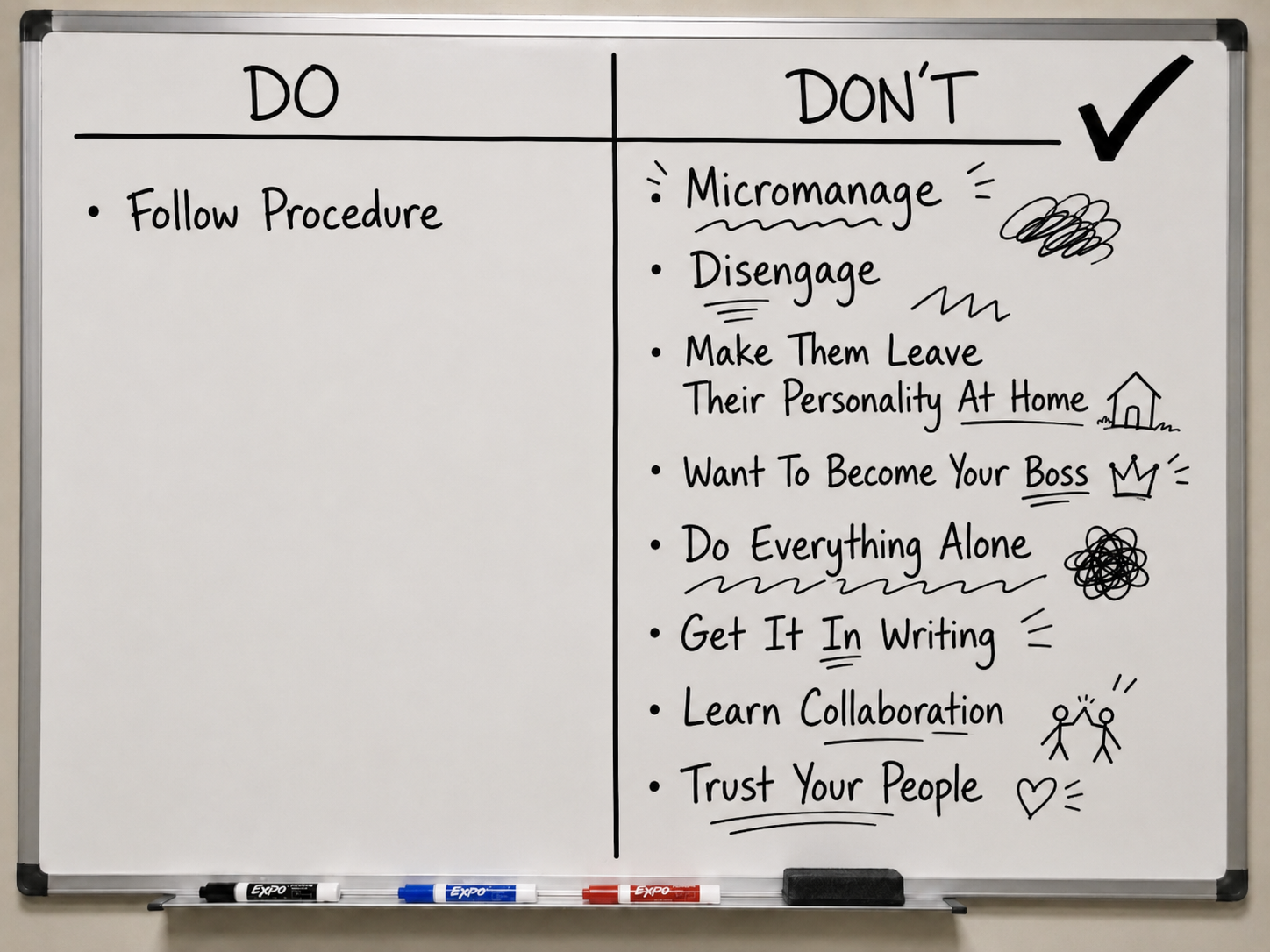
I cannot explain it, but it seems that anti-lessons are often more memorable and meaningful than positive lessons.
For this reason, my advice for young people, and business owners of any age, is to get experience. Go ahead and learn some lessons the hard way.
There is no way to avoid this part, and you wouldn’t want to.
Good or bad, you’re going to learn by observing and doing.
You’ll be stronger and wiser for it.