


"Your business isn’t a house."
— Craig Doescher
A business can’t be valued from a few data points like a house, so free online calculators fall short.
A limited business valuation is the better first step to learn what your business could actually sell for.
"How much is my business worth?" is one of the most common questions I hear from business owners.
More than once, I’ve had a business owner in a social setting find out what I do, and pivot the conversation into a request for me to tell them what their company’s worth. “Just a ballpark!” And I won’t do it. I can’t do it in good conscience. And neither can AI (although AI doesn’t have to worry about the whole “conscience” thing).
Until the day I retire from Doescher Group, I won’t stop telling people that your business isn’t a house. With a house you might be able to take a few inputs like zip code, square footage, rooms, and date built to arrive at a reasonable estimate of your home’s value. But that’s simply not how it works for your business.
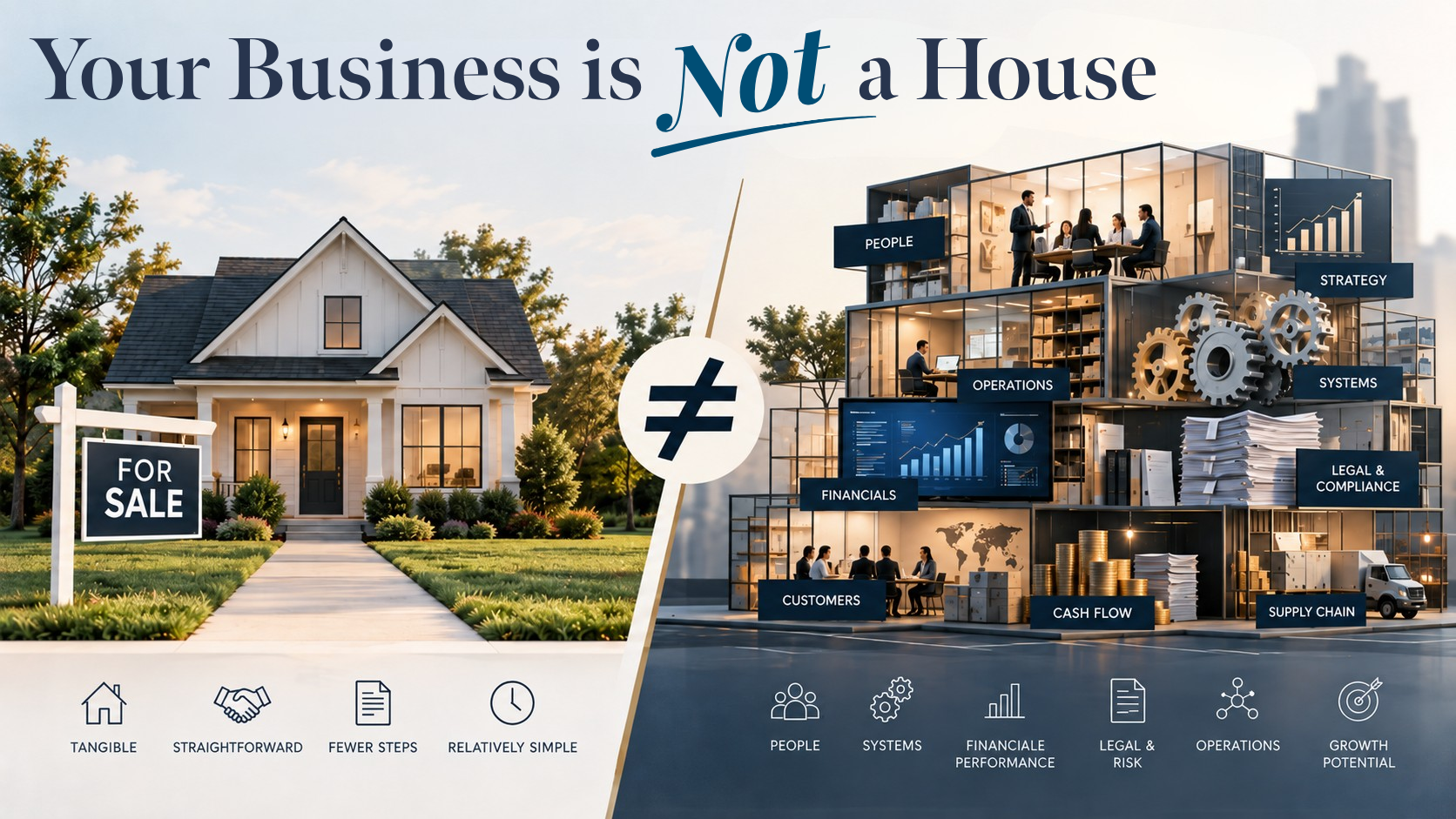
Business Valuation is a far more nuanced story. It cannot be distilled down to a few specific data points that you can feed to even the smartest AI enabled tool or online valuation calculator (at least not yet!). That may change someday, but it isn’t the case today. We’ve done the research, and our experience backs it up.
A Better Question Than, “What is My Business Worth?”
When it comes to what your business might actually sell for, the better question is, “Are you FieldReady™?”
In other words: is your business attractive to buyers, and is it also ready for the scrutiny that will come if you’re lucky enough to attract a qualified buyer. (Download our free resource, The FieldReady™ Scorecard, to see where you stand.)
What This Article Doesn't Cover:
Valuations for Other Purposes
To be clear, we’re not discussing business valuations done for reasons other than selling at least a majority interest in your company to a qualified third party buyer.
Valuations for other purposes are valid and often necessary. They include:
Estate planning and gifting
Shareholder buy/sell agreements
Family disputes
Lender required fair market valuations
Other statutory, regulatory, or contractually obligated valuations
These are valuations that may be related to a transaction, but they’re outside of the scope of this article. I would argue that even in these cases, a free valuation calculator is completely insufficient, potentially misleading, and likely to cause more harm than good. But I do want to make it clear that we are not talking about these specific scenarios.
What We Are Covering: What Your Business Could Actually Sell For
We are talking about what your actual business would likely sell for to a third party on the open market.
In other words, an actual deal between unrelated buyers and sellers who agree to a price that both find acceptable, and get that transaction over the finish line.
Why the Price of Your Business Depends on the Story You Tell

Over many years of doing this work, we learned that selling a business is all about the story. The data matters and so does how you present it. The story doesn’t tell itself.
You’ve probably heard a version of this quote attributed to Ralph Waldo Emerson: “If a man can write a better book, preach a better sermon or make a better mouse-trap than his neighbors, though he builds his house in the woods, the world will make a beaten path to his door.”
We disagree. If you have built a better mouse-trap (business), you still need to get out there and tell people about it. The world (investors) will not find you in the woods on their own. You need to lead them where you want them to go.
Two client stories show how this plays out.
Case Study: A Medical Practice Sale Where Asking Paid Off
A few years back, we were advising a medical practice. We had a very interested investor taking a hard look at the practice. They had submitted an offer, but the terms didn’t work for our client. Throughout the negotiating process, the business broker representing the practice in the sale process (i.e. working for the same client we were) repeatedly advised the client not to ask for this or that change. The business broker warned us that the buyer “would not go for that” and might walk away just because we asked.
Rather than simply making requests, we focused on telling the client’s story and articulating why we thought our requests were fair and reasonable. Each time, the broker tried to dissuade our client. In the end, not only did the buyer not walk, but they accepted basically every request we submitted.
An online valuation calculator can’t do this.
Case Study: Getting Past a "Best and Final Offer" in a Manufacturing Sale
In another deal, we helped a manufacturing company hire an investment banker to run the sale process. The banker generated investor interest and we received an offer. Again, the investment banker told our client numerous times that this buyer was putting forth their “best and final offer”. Every time we submitted a counteroffer. And what do you know? The buyer relented and gave us some (not all) of what we asked. Each round moved the value up for our client.
How did we do this? By telling the story and articulating the value proposition to the buyer in a way that they could understand.
That’s something an online valuation calculator cannot do.
How to Find Out What Your Business Is Really Worth
We could go on and on with examples of how just our small company has made our clients millions of dollars of incremental proceeds by telling the story better. But suffice it to say, an online valuation calculator just won’t get the job done.
Knowing how to value a business to sell takes more than a formula.
You need humans with expertise on both sides of the table.
Your first step is a limited business valuation which is often where we start with our clients here at Doescher Group.
Related Read: The Limited Business Valuation: How to Know What Your Business May Be Worth
Our valuation process looks much deeper under the hood than an online calculator. From that report, you will have a sense of:
Is my business salable or not?
If so, what is an expected value range and where do I reasonably sit in it?
At Doescher Group, one of our core values is: Always the truth. We cut right to the heart of the matter with our clients, set reasonable expectations, and then go to work on doing our absolute best. This costs more than a free online tool, but you can rely on it.
Free Online Calculator vs. An Expert Valuation
Here’s how the two options compare on the things that decide what a buyer will pay.
| What to compare | Free online calculator | Expert valuation (Doescher Group) |
|---|---|---|
| What it looks at | A few inputs, like a home value estimate | Your whole business, in depth |
| Reflects what makes your business unique | No. A business can't be boiled down to a few inputs | Yes. It's built around your specific business |
| Presents your story to buyers | No | Yes. Experienced people present your value to buyers |
| Helps you negotiate | No | Yes. In past deals, telling the story raised the value for clients |
| What you walk away with | A rough number | Whether your business is salable, the expected value range, and where you sit in it |
| Cost | Free | Costs more, and you can rely on it |
A calculator gives you a number. An expert valuation tells you whether your business can sell and for roughly what.
Ready to find out what your business is worth?
Contact Doescher Group to start a no pressure conversation with our team.
Frequently Asked Questions
Can an online calculator tell me how much my business is worth?
Not reliably. Business valuation can’t be boiled down to a few data points you feed into an online calculator or even an AI tool, at least not today. That may change someday, but it isn’t the case now.
Why can’t a business be valued like a house?
With a house, a few inputs like zip code, square footage, number of rooms, and year built can give a reasonable estimate. A business is far more nuanced. What it sells for depends on factors a simple formula can’t capture, including how its story is told to buyers.
What is a better question than “What is my business worth?”
A better question is “Is my business FieldReady™?” That means two things: your business is attractive to buyers, and it’s ready for the scrutiny that comes once a qualified buyer is interested. The FieldReady™ Scorecard can show you where you stand.
Why does the story matter when selling a business?
The data matters, and so does how you present it. Investors won’t find a great business on their own. Someone has to explain its value in a way buyers understand. In Doescher Group’s experience, telling the story well has led to better terms and higher sale prices for clients.
Is a buyer’s “best and final offer” really final?
Not always. In one manufacturing company sale, the buyer’s offer was described as “best and final” several times. Each time, Doescher Group submitted a counteroffer explaining the company’s value. The buyer gave some, but not all, of what was asked, and each round raised the value for the client.
Will asking for better terms make a buyer walk away?
Not necessarily. In a medical practice sale, the broker warned that certain requests could make the buyer walk away. Doescher Group explained why each request was fair and reasonable, and the buyer stayed and accepted nearly every request.
What is the first step to find out what my business could sell for?
A limited business valuation is often where Doescher Group starts with clients. It answers two key questions: Is my business salable? And if so, what is the expected value range, and where does my business reasonably fall in it?
Does this apply to valuations for estate planning or buy/sell agreements?
No. This article focuses on selling at least a majority interest in your company to a qualified outside buyer. Valuations for estate planning, gifting, buy/sell agreements, family disputes, lender requirements, or legal and regulatory purposes are a separate topic. Even in those cases, though, a free calculator is not enough and can be misleading.
Thinking of
Selling Your Business?

Thinking about your own exit one day?
The owners who sell well start years early. Let's talk about yours.
The FieldReady™ Scorecard
The FieldReady™ Scorecard is a 20-point diagnostic across the four areas buyers evaluate first.
It takes about five minutes to complete and gives you a clear picture of where your business stands today, and what's worth improving before any transition conversation begins.