

Anger Is a Secondary Emotion: What Great Leaders Do Instead of Exploding
Years ago, when I was promoted to a new job that gave me more responsibility, I noticed something unsettling: I got angrier more often.
Suddenly, I wasn't the happy-go-lucky Tommy of the past, and at times, my reactions were clearly disproportionate to the situation/problem at hand.
To be honest, I blew up.
Fortunately, before I caused too much damage or embarrassment, I received some sage counsel that has stayed with me ever since: Anger is usually your second emotion.
Why Do Good Leaders Get Angry?
For me, I discovered the primary issue behind my anger was often a build-up of frustration. That insight changed everything. I was introduced to a wonderful one-page write-up and chart on the topic (link under the image of ‘Anger Iceberg’, below). I still keep this chart in my daily journal and return to it often as a reminder. If you can relate to my story, I would recommend you do the same.
Once I began to understand what was going on beneath the surface, my mentor suggested that I deal with issues as they arose, long before they escalated.
How To Handle Your Anger As The Boss?
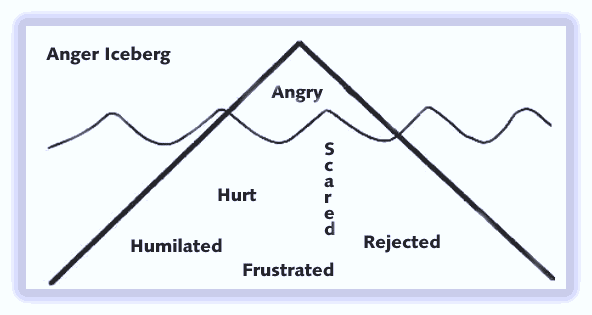
Image from Men For Change, The Online Healthy Relationships Project, 1998 and Creducation: Anger Iceberg
Here's an example: imagine someone on your team has an annoying habit or practice that bothers you and the team. Too often, out of politeness or uncertainty, no one mentions how they're feeling about the situation.
It feels like you’ve avoided an uncomfortable moment, but actually, it’s just postponed until someone reaches their breaking point.
With no warning, a team member becomes the target of an angry outburst, even though they may have had no idea their behavior was causing a problem.
Now you have a much messier situation to deal with.
I learned — and am still refining — the practice of healthy confrontation, or as I like to put it, speaking the truth in love.
Over the years, I've discovered that if I keep short accounts — in other words, address the small things before they become big things — I avoid the big explosion.
How about you? Can you relate?
Do you find yourself reacting in anger when the real issue is something deeper, like frustration, disappointment, or fear?
Do you avoid healthy confrontation, only to find yourself blowing up later?
What would change if you committed to keeping shorter accounts with your team, your family, or even yourself?
Leaders set the tone for their teams. If you learn to pause and ask, “What’s really behind my anger?” you not only avoid unnecessary explosions, but you also model self-awareness for those around you. In the long run, this builds healthier relationships, stronger trust, and a culture where problems are addressed before they spiral.
If you’ve struggled with anger in leadership, don’t wait until the “explosion.” Start small this week: choose one slightly uncomfortable conversation you’ve been putting off and practice healthy confrontation. And if you’d like help building these kinds of self-awareness practices into your leadership, our Executive Coaching team would be glad to discuss your concerns with you.