

Sports can provide some of the clearest examples of leadership, preparation, accountability, and teamwork.
Years ago, Barbara and I read a Harvard Business Review interview with Sir Alex Ferguson, who led Manchester United for 26 seasons before retiring in 2013.
Ferguson’s story is not simply about winning games. It is about building an organization that can identify talent, maintain standards, prepare consistently, respond to change, and continue succeeding after individual players come and go.
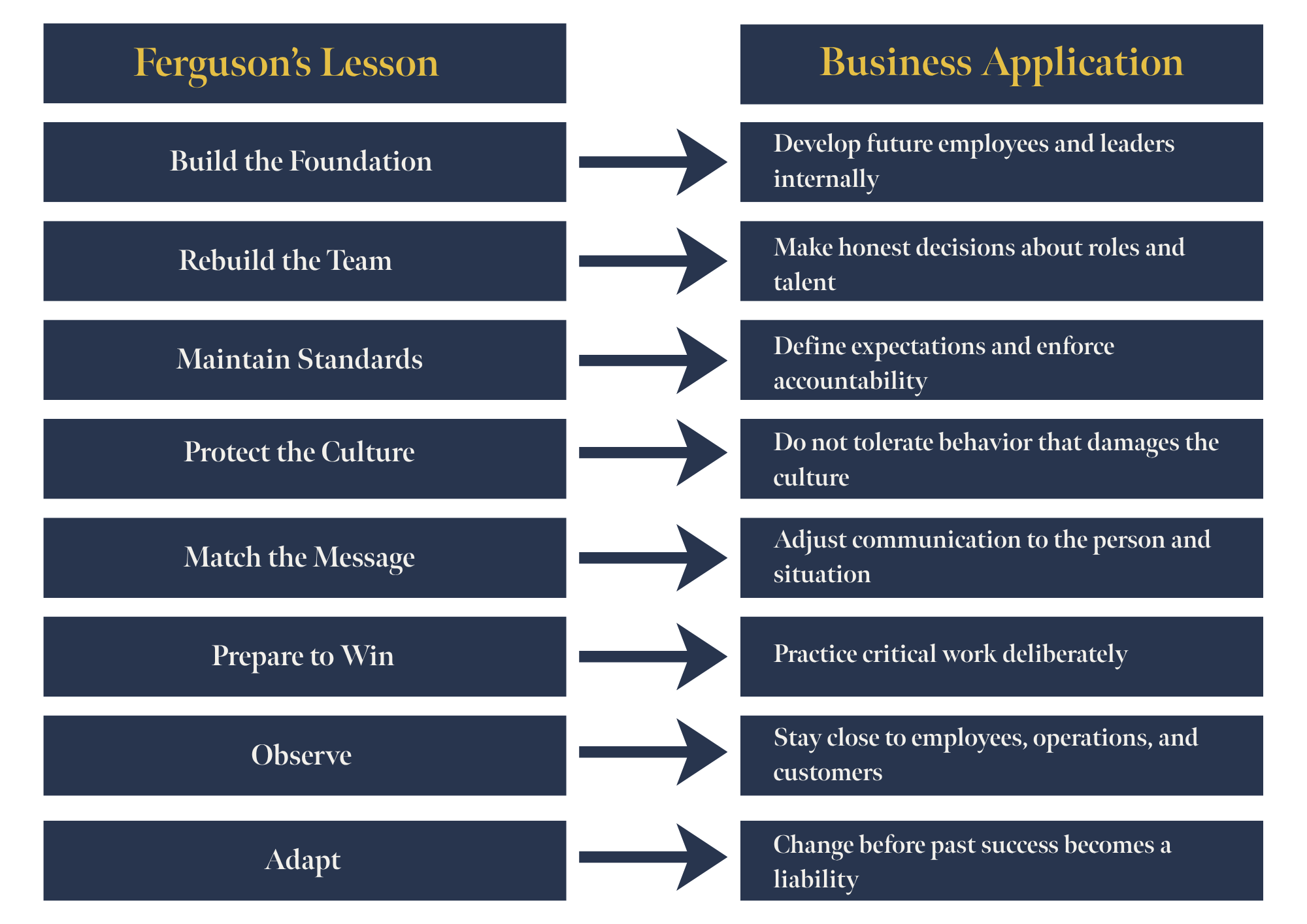
Harvard Business School professor Anita Elberse organized Ferguson’s approach into eight leadership lessons.
Each one has a practical application for business owners who want to build stronger teams and more valuable companies.
1. Build the Foundation Before You Need It
Coach Ferguson reported that the first thought of most newly appointed managers is to make sure they win. That ensures they will survive. To accomplish that goal, they often bring in experienced players because they are in a results-driven industry. Editorial comment: does that sound familiar?
Coach Ferguson’s focus was on building a club, not just winning a game. His team’s youth development efforts ended up contributing to many of their successes.
Application: Most companies seem to need more supervisors, skilled associates, and high-level executives. Often, their only solution is to hire from the outside. The most successful companies, however, have their own “youth development” program.
They have a well-oiled developmental system at all levels, from operators to future C-level executives, including apprentice programs, internships, mentoring, and leadership development.
If they know they will need great people, they take responsibility for growing their own.
2. Rebuild the Team When Necessary
Coach Ferguson admitted that managing the talent-development process inevitably involved cutting players, including those he had a personal attachment to.
Rebuilding a team does not mean treating people as disposable. It means evaluating roles honestly, giving people clear expectations and appropriate support, and acknowledging when the needs of the company and the strengths of the individual no longer align.
Application: If you want to succeed in the long term, do not settle for less than the best. This does not mean leaders should be harsh or careless with people. It does mean they must be honest about whether the current team can take the company where it needs to go. Sometimes the kindest thing a leader can do for the company, the team, and even the individual is to tell the truth.

3. Set Clear Standards and Enforce Them
Coach Ferguson wanted to inspire his players to strive to do better and to never give up. In other words, he wanted to make them winners.
Application: Do you provide clear direction to your team? Once that has been done, do you hold them accountable?
Many leaders say they have high standards, but the real test is what happens when those standards are missed. If expectations are unclear, accountability feels unfair. If expectations are clear but ignored, the leader loses credibility.
4. Protect the Culture from Destructive Behavior
An important part of maintaining high standards was Ferguson’s willingness to respond forcefully when players violated the team’s standards and values. In 2005, a longtime captain publicly criticized his teammates, and his contract was terminated. Ferguson recommended responding quickly before situations get out of hand.
Application: Once again, the coach provides some sage advice. Often, a team is better off without a big-ego superstar. Business owners can be tempted to tolerate destructive behavior from a high performer because the person produces results. The problem is that everyone else is watching. Culture is shaped not only by what you say, but by what you tolerate.
5. Match the Message to the Moment
Ferguson found it useful to remind players how far they had come. He would tell them that having a good work ethic was very important. He also said that, as a manager, you play different roles at different times. Sometimes you have to be a doctor, a teacher, or a father.
Application: Everything Coach Ferguson said applies to business. Leaders need to know when to encourage, when to teach, when to correct, and when to simply listen. The right message at the wrong time may not help. The right message at the right time can change a person’s confidence, effort, and direction.
6. Practice the Work You Want to Improve
Manchester United’s practice sessions focused on repeating skills and tactics. Coaches and players looked at training sessions as opportunities to learn and improve. This type of mindset sends an underlying message that you are never quite satisfied with where you are and are constantly looking for ways to improve.
Application: Ferguson’s advice reminded us of Geoff Colvin’s book Talent is Overrated. Colvin used the phrase “deliberate practice,” meaning focused preparation on the specific work you are trying to improve. Businesses need this too. Great execution rarely happens because someone gave a motivational speech. It happens when people prepare, practice, review, adjust, and improve.
7. Lead Through Observation
Ferguson said he did not think many people fully understood the value of observing. He came to see observation as a critical part of his management skills. The ability to see things, especially things you do not expect to see, is key.
Application: When we read this lesson, we immediately thought of the 1982 Tom Peters and Robert Waterman book In Search of Excellence. It was the first time we were exposed to the phrase “management by wandering around,” which was originally used at Hewlett-Packard. The best business owners and executives we know find a way to get out of their office and into the plant, other offices, and customer facilities.
Because of all the technology available today, we observe far too many executives managing from their office, even though their team members and customers love to see them.
8. Adapt Before Change Forces You To
Finally, Ferguson said one of the things he had done well over the years was manage change. He believed you control change by accepting it. Most people with his kind of track record do not look to change, but he felt he could not afford not to change.
Application: That is a powerful reminder for business owners. Past success can become one of the greatest threats to future success. When something has worked for a long time, it is tempting to protect it, repeat it, and defend it. But markets change. Customers change. Technology changes. Team expectations change. Leaders who refuse to adapt eventually put their companies at risk.
We hope you have picked up at least one idea to improve your business and increase your profitability. As one of our colleagues used to say, it is all in the execution.
Championship teams do not happen by accident. Neither do healthy, valuable companies. Both are built through disciplined leadership, consistent preparation, clear standards, and the willingness to keep adapting.