

Execution, Execution, Execution
Over the years, I've read countless business books. Some of them were particularly special — a new concept, a fresh take on an old one, or what I like to call a genuinely "fresh" idea. Of those, only a handful were what I'd call high impact. One of those was The 4 Disciplines of Execution (4DX), which tackles a problem nearly every business I've ever worked with struggles to solve.
The 4 Disciplines of Execution: Achieving Your Wildly Important Goals by Chris McChesney, Sean Covey, and Jim Huling addresses an issue with which most businesses struggle.
Let me start with a question I ask a lot of owners and senior executives: what's harder for your company — strategy or execution? Almost without exception, the answer is execution. Everyone has a plan. Far fewer make the plan actually happen.
Now think about your own training. In all your formal education — business school, degree programs, the works — how many classes did you take on execution? Probably none. In your postgraduate development programs, how much time was devoted to it? Most likely, very little. We're taught how to think up the strategy and almost never how to land it.
According to the authors, there are three primary reasons businesses fail to execute: a lack of clarity about the objective, a lack of commitment, and a lack of accountability.
The book centers on what it calls a Wildly Important Goal, or WIG — a significant initiative, strategy, or goal that genuinely matters. The authors ask leaders to make a major mindset shift: think of the WIG as something above and beyond your day-to-day operations — your "day job," which they've aptly labeled the Whirlwind.
Editorial comment: I think the fact that so many people fail to even recognize their Whirlwind is one of the single greatest contributors to WIG failure. You can't carve out room for what's important if you won't admit how much of your week the urgent already swallows. And for owner-operated businesses, the Whirlwind isn't a department — it's usually the owner. You are the Whirlwind. That's exactly why these goals stall.
The authors propose spending about 80 percent of your time on the Whirlwind and 20 percent on your WIG(s).
Editorial comment: in my experience, 20 percent seems high for most owner-operated businesses, which are already running pretty lean. If 20 is unrealistic for you, don't let that be your excuse to do zero. Even a protected 5 or 10 percent, applied consistently, beats a heroic burst you can't sustain.
Based on surveys of more than 300,000 leaders and team members, the authors identified four disciplines that show up again and again in organizations that consistently hit their goals:
Discipline 1: Focus on the Wildly Important
Discipline 2: Act on the Lead Measures
Discipline 3: Keep a Compelling Scoreboard
Discipline 4: Create a Cadence of Accountability
Let me take them one at a time.
Discipline 1: Focus on the Wildly Important
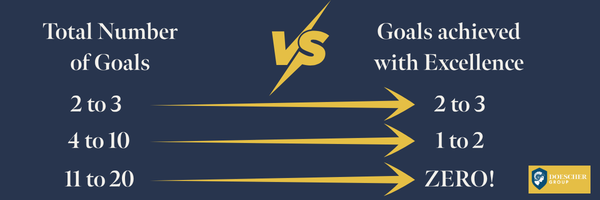
Most organizations have too many goals — and finish almost none of them. See the chart on the right. The data is sobering.
Read that last row again. Chase 11 to 20 goals at once and you accomplish none of them with excellence. Steve Jobs' focus at Apple was legendary precisely because he understood this. People who try to push too many goals at once usually wind up doing a mediocre job on all of them.
So how do you choose your one WIG? Ask this question: "If every other area of our operation stayed exactly where it is today, what is the one area where change would have the greatest impact?" Your WIG usually comes from one of three places:
something so badly broken it simply must be fixed,
an opportunity to leverage a real strength, or
the launch of a new product or service.
Here's the test: the battle you choose must win the war. A WIG that, even if achieved, wouldn't meaningfully move the business isn't wildly important — it's just busy.
Every WIG also needs a specific finish line and a firm time frame. In the early 1960s, President Kennedy declared the intention to "land a man on the moon and return him safely to the earth before this decade is out." (Paraphrased.)
Editorial comment: this is far easier said than done — but a clear, time-bound finish line dramatically increases your odds of success.
Notice what Kennedy's proclamation did: accountability across the space industry soared, and morale and engagement went right through the roof. A clear, worthy finish line does that.
Discipline 2: Act on the Lead Measures
This is the discipline most owners skip, and it's the engine of the whole thing.
A lag measure tells you whether you've already achieved the WIG — revenue, profit, the final score. By the time you read it, the game is over. A lead measure (LM) tells you whether you're likely to achieve the goal, while there's still time to do something about it.
A good lead measure has two traits: it's predictive (if you do this, then that will follow) and it's influenceable (you and your team have roughly 80 percent control over it). Think of Billy Beane, the Oakland Athletics' general manager, whose story Michael Lewis told in Moneyball. Beane won by obsessing over the few statistics that actually predicted runs — the lead measures — instead of the ones everyone else was watching.
When you're hunting for your own lead measures, ask:
Does it start with a verb — make, raise, improve, increase?
Is it simple?
And review your processes to find candidates: your bottlenecks are often exactly where your most powerful lead measures are hiding.
Discipline 3: Keep a Compelling Scoreboard
"People do what you inspect, not what you expect."
Here's a truth I've watched play out in company after company: people play differently when they're keeping score. And just as importantly — people disengage when they don't know the score.
Editorial comment: in Who Says Elephants Can't Dance, Lou Gerstner says, "People do what you inspect, not what you expect." That line has stuck with me for years, because it's the difference between a goal and a wish.
To actually drive execution, the team's scoreboard needs just a few simple graphs that make one thing obvious: we need to get from here to there. The standard is this — in five seconds or less, anyone should be able to glance at it and know whether the team is winning or losing.
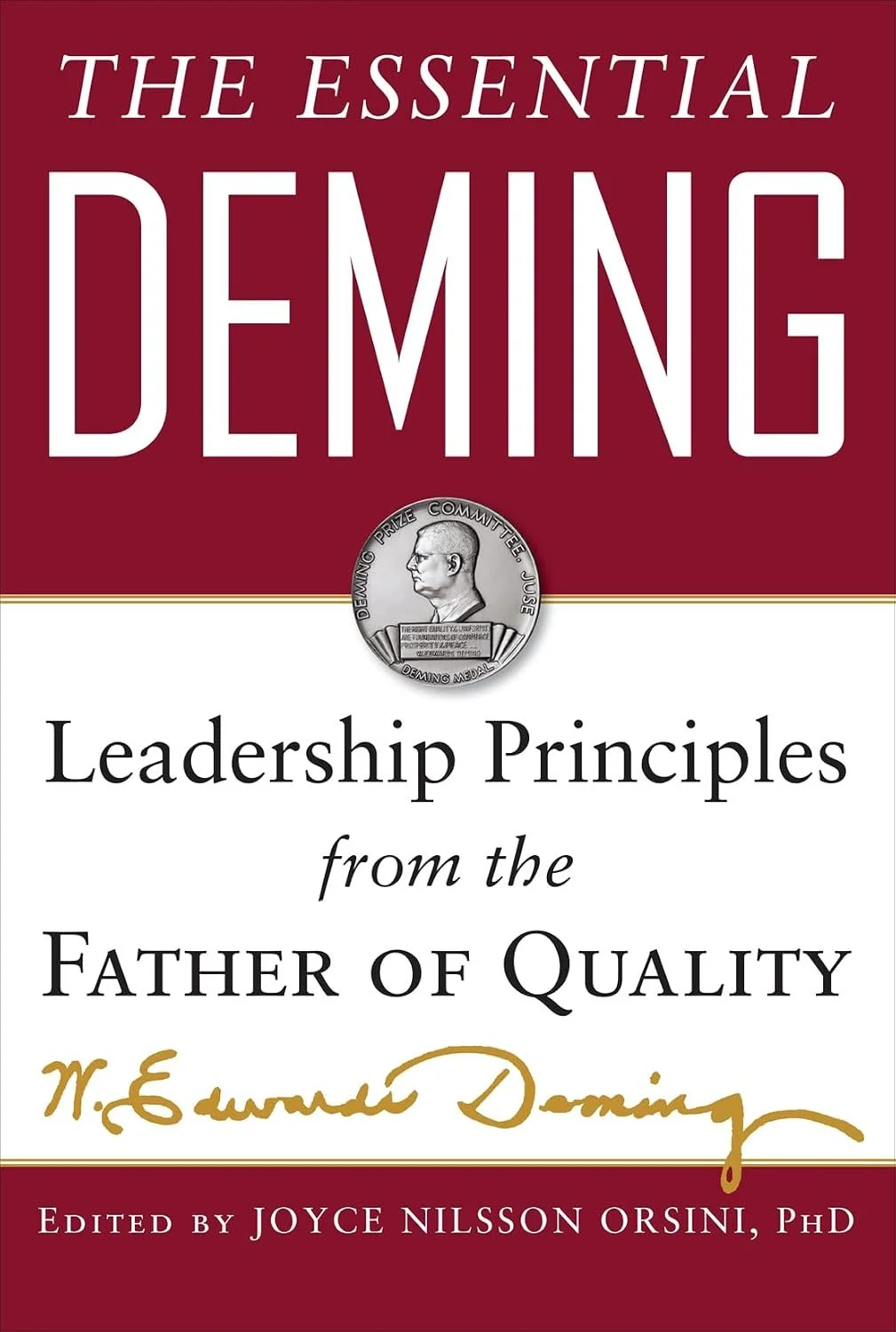
Editorial comment: I'm a huge fan of Dr. W. Edwards Deming, the founder of the modern quality movement. Unfortunately, leaders heard only part of his message — and in the rush toward total quality management, ISO, QS, and the rest, a lot of companies ended up building far too many complicated charts. Keep it simple.
Try this. Think of a time when you were most excited and engaged in what you were doing. Now ask yourself: at that moment, did I feel like I was winning? I'd bet you did. Winning is engaging — and you can't feel like you're winning if no one's keeping score.
Editorial comment: the leader may keep other scoreboards to help run the business, but dumping all of that on the team usually just overwhelms them. I once had a client say to me, a little indignantly, "I can track whatever I want!" My response was, "Absolutely. Just don't confuse your team with it."
Discipline 4: Create a Cadence of Accountability
Great teams operate with a high level of accountability — and accountability isn't a personality trait, it's a rhythm.
The authors recommend meeting at least weekly, but with two firm rules: a set agenda, and a hard stop at no more than 30 minutes.
Editorial comment: later in my business life I had a small epiphany — why do we default to scheduling every meeting for an hour? Why not a 15-, 30-, or 45-minute meeting when that's all the work actually requires? Give the time back to the Whirlwind. People will thank you.
A simple weekly WIG meeting runs like this:
Account — each person reports on the commitments they made last week.
Review the scoreboard — learn from both the wins and the losses.
Plan — clear the path and make new commitments: one or two actions per person that will move the lead measures.
That's it. Account, review, plan. Short, consistent, and relentless. The cadence is what turns a good intention into a habit — and habits are what eventually let a business execute without the owner standing over it. That, not coincidentally, is also exactly what makes a company more valuable and more sellable down the road: a business that hits its goals on rhythm, whether or not the founder is in the building.
A Final Word
The first third of the book lays out the 4DX concept; the rest is full of specific, real-world implementation issues, how-tos, and helpful checklists and forms. I loved it — though I'll be honest, it was written by consultants and reads a bit like a textbook. If you want the full set of details and examples, go ahead and read it.
But whether you read it or not, here's my challenge to you: pick one WIG in the next month and give it a shot. One wildly important goal. A clear finish line. A simple scoreboard. A weekly cadence. Then let me know what happens.
Good luck: Seek. Climb. Lead.